
May 11th, 2026 (16h-17h CET)
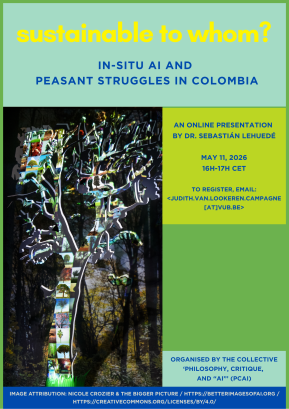
Online presentation by dr. Sebastián Lehuedé (King’s College London):
Sustainable to Whom? In-Situ AI and Peasant Struggles in Colombia
Many 'AI for sustainability' initiatives pursue ambitious goals such as emissions reduction, yet local impacts and alternative approaches have been largely overlooked. Drawing on ethnographic fieldwork in Colombia, this talk analyses two initiatives: one by Microsoft in the Amazon and another by peasant communities in the High Andes. Through this analysis, it traces the emergence of 'in-situ AI', highlighting its capacity to engage with local ecological struggles and address environmental injustices. Nevertheless, questions remain about the capacity of in-situ AI to address urgent, planetary-scale environmental challenges.
More information about the speaker: https://slehuede.me
To register, please send an email to: < judith.van.lookeren.campagne[at]vub.be >
This presentation is organised by the collective ‘Philosophy, Critique, and “AI”’ (PCAI):
The international collective Philosophy, Critique, and 'AI' (PCAI) consists of early career researchers working on questions regarding so-called “Artificial Intelligence” (“AI”) from a predominantly philosophical perspective. The PCAI group seeks to foster space for politicised philosophical reflection on “AI”, while refusing to succumb to overly simplistic characterisations of either ‘salvation’ or ‘demise’. Being a collective, PCAI creates such space through various activities. The group is for early career scholars at any stage in their PhD/post-doc working on critical philosophical approaches to ‘AI’. The collective understands techno-scientific practices to be situated within social structures that are in turn embedded in logics of domination. As such, we recognise that political reflections on ‘AI’ should be approached through a plurality of different critical theoretical (e.g., sociopolitical, epistemic, normative) lenses, which pertain to minoritised (e.g., feminist, decolonial, queer) perspectives. Ultimately, the aims of the PCAI are twofold: to reflect on how and why critical theorisations are carried out, but also to question how the term ‘AI’ is (continuously) constructed, used, and enforced.